
There is nothing worse for a car owner than not knowing when a particular component of his vehicle will fail. Although some automotive components have a predictable and expected life span; while others appear to fail randomly; while yet other parts may be replaced several times during the course of a vehicle’s operational life.
Identifying the expected life spans of different automotive components assists in establishing appropriate expectations for a vehicle’s operation and also identifies premature failures which may be symptomatic of a greater problem. Not every early failure is simply the result of poor luck, sometimes an early failure is indicative of a greater problem occurring.
Automotive Components With Predictable Life Spans:
As mentioned previously, certain automotive components have predictable life spans due to their intended design function. These types of automotive components include those that are expected to wear out as a result of normal usage.
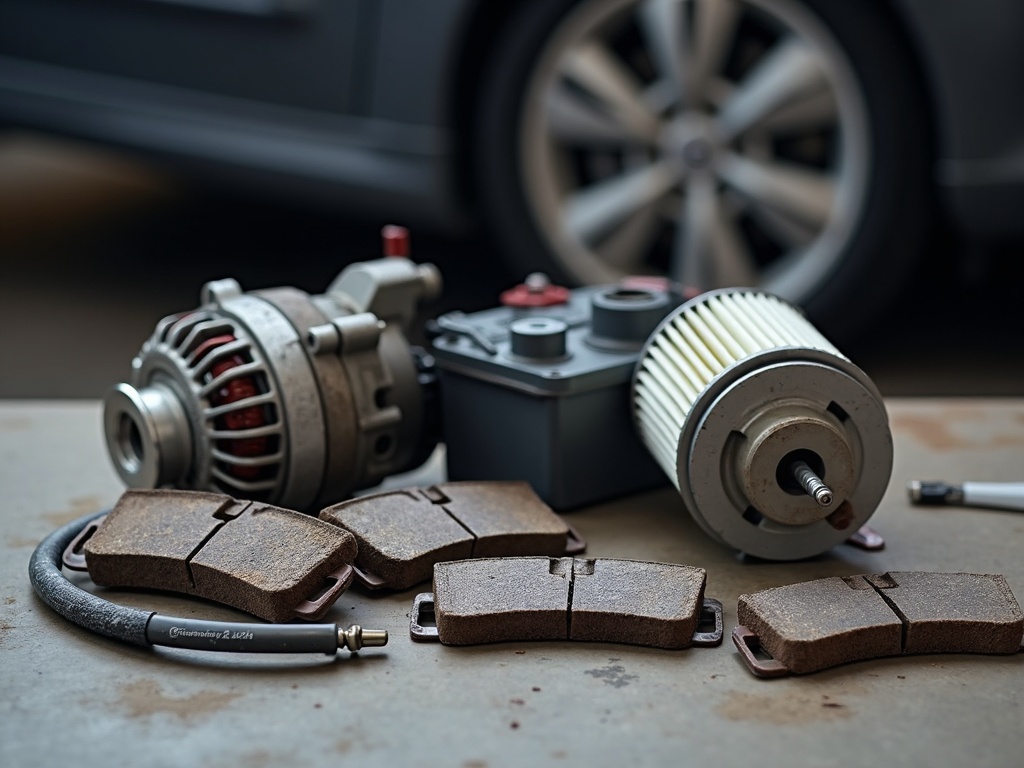
Brakes Pads: Brake pads are a classic example of a component that will eventually require replacement. The average life expectancy of brake pads is approximately 40,000 to 100,000 kilometers. The exact length of time that brake pads last depends on the driver’s driving habits and the conditions in which the vehicle is being driven. City driving involves stopping and starting frequently, which tends to increase the rate of wear on brake pads. On the other hand, highway driving is a continuous flow of speed and thus reduces the rate of wear on brake pads. In addition, the manner in which a driver applies the brakes affects the longevity of brake pads. Drivers who apply the brakes aggressively will experience shorter life spans for their brake pads compared to drivers who apply the brakes more gently.
Tires: Tires have a similar life expectancy to brake pads. Tires for passenger automobiles typically last 50,000 to 80,000 kilometers under standard operating conditions. Improper tire inflation and/or irregular tire rotation will reduce the life of tires, while proper inflation and/or regular tire rotation will extend the life of tires. Tire manufacturers have developed tread wear indicators located on the sidewall of each tire which assist in identifying when the tire needs to be replaced.
Battery Life: Batteries are less predictable than brake pads and tires. However, batteries generally last 3 to 5 years, depending upon environmental conditions. Extreme temperatures (both high and low) will significantly affect battery life.
Maintenance Items: Maintenance items such as motor oil and filters have the shortest life expectancy of any automotive component. Motor oil should be changed every 5,000 to 15,000 kilometers, depending on the type of oil being used and the operating conditions of the vehicle. Filters should also be changed according to the recommendations outlined in the owner’s manual of the vehicle.
Components Designed To Last The Lifetime Of The Vehicle:
Several automotive components are designed to last the lifetime of the vehicle provided that they receive regular maintenance. Therefore, when these components fail prematurely, it is likely an indicator that there is a problem somewhere in the vehicle.
Engines: Engine blocks are extremely durable and can last for hundreds of thousands of kilometers. The engine block itself is the central component of an automobile engine and serves as a housing for the crankshaft, camshaft(s), valves, etc. Provided that the engine receives adequate lubrication, cooling, and fuel, it can easily operate for 300,000 to 500,000 kilometers or more. However, the components that are attached to the engine (such as sensors, gaskets, and hoses) will require replacement much earlier in the life of the engine.
Transmission: Transmissions are also designed to last the lifetime of the vehicle provided that they receive regular maintenance, including routine fluid changes. An automatic transmission can last 200,000 kilometers or more, although an automatic transmission that lasts only 100,000 kilometers suggests that the transmission was not receiving sufficient fluid or had experienced excessive heating. A manual transmission is capable of lasting even longer, assuming the driver operates the clutch correctly.
Suspension Components: Suspension components such as control arms and subframes are typically designed to last for the lifetime of the vehicle. Bushings and ball joints contained in suspension components do wear down over time, however, the primary structure of the suspension components will rarely fail unless the vehicle has experienced an accident or has suffered extensive corrosion.
Middle Ground Parts:
In addition to parts that have a predictable life expectancy and parts that are designed to last the lifetime of the vehicle, there exists a third group of components that do not have a predictable life expectancy, but are not designed to last the lifetime of the vehicle. These components are the ones that create the most confusion among car owners, since their life expectancy can vary greatly depending upon quality, usage and simple luck.
Alternators: Alternators are typically designed to last 100,000 to 150,000 kilometers. However, some alternators fail earlier, while others continue to function for much longer. Alternators do not gradually deteriorate and typically function perfectly until they fail.
Starters: Starters have a similar life expectancy to alternators. Typically, starters are designed to last for 100,000 to 200,000 kilometers. The life expectancy of a starter can vary widely depending on the specific starter and the conditions in which it is used. A starter that fails at 50,000 kilometers is considered to be premature.
Water Pumps: Water pumps are unique in that their life expectancy can be related to the life expectancy of the timing belt or serpentine belt that drives them. Many mechanics recommend replacing the water pump when the timing belt is replaced (usually at 100,000 to 160,000 kilometers) because the labor involved in accessing both belts is the same. A water pump that fails at 60,000 kilometers would be considered to be premature.
Radiators: Radiators can last for 10 years or longer. However, radiators are prone to corrosion if the coolant is not changed on a regular basis. If a radiator fails at 5 years, it is likely that the coolant was not changed regularly.
Replacing Failed Components:
Once the components fail, there are various options available for obtaining the replacement parts. Original Equipment Manufacturers (OEM) dealerships stock OEM parts, but they are typically expensive. Aftermarket manufacturers produce alternative products that can be purchased at different price points and quality levels. Salvage yards can also be used as a source of parts for many of the components listed above, as these salvage yards sell tested parts from vehicles that were dismantled. Organizations providing Car Spare Parts in Perth and other locations can be particularly useful for owners of vehicles that have middle ground parts that do not wear out on a schedule.
Matching the type of component with the appropriate part supplier is essential. Wear items that need to be replaced on a regular basis may be candidates for lower priced aftermarket parts. Safety critical parts and complex electronic parts may benefit from using OEM parts. More durable parts that rarely fail can be reasonable candidates for purchasing quality used parts when they do fail.
When Premature Component Failure Is Indicative Of A Larger Problem:
Understandably, establishing the expected lifespan of the various automotive components provides a great deal of value. Establishing the expected lifespan of the automotive components also provides a means of determining whether a component failure occurred prematurely, and if so, whether the premature failure is symptomatic of a larger problem.
For example, brake pads that fail at 20,000 kilometers suggest that there is a problem with the vehicle. Brakes that fail prematurely can be caused by sticking calipers, contaminated brake pads, or severely damaged rotors. Simply replacing the brake pads without addressing the underlying problem ensures that the new brake pads will wear out prematurely again.
Similarly, a battery that dies after a year of service is usually indicative of an electrical drain. Perhaps a door switch is faulty and is causing a light to remain illuminated. Or perhaps the alternator is not charging the battery adequately. Installing a new battery without locating the drain represents a waste of money.
Finally, uneven or premature wear on tires can be attributed to misalignment of the vehicle’s wheels or improper adjustment of the vehicle’s suspension. While the driver must replace the tires regardless, the premature wear will occur again once the new tires are installed if the problem persists.
Repeated failures of the exhaust system (particularly on newer components) may be indicative of a problem with the engine. A vehicle with a recurring problem with the exhaust system may be experiencing engine problems, such as burning oil or running excessively rich, which contaminates the catalytic converter. Replacing the exhaust components without addressing the underlying engine issue will only result in repeated failures.
Understanding Normal Variation and Setting Expectations:
The challenge with establishing expected lifespans for automotive components is that significant variation exists even under normal operating conditions. Two identical vehicles driven in similar conditions can experience different component lifespans due to manufacturing variations, slight differences in usage patterns, and random chance.
A water pump failing at 80,000 kilometers instead of 120,000 kilometers is not necessarily cause for concern. However, a water pump failing at 40,000 kilometers warrants further investigation. Similarly, a battery lasting three years is perfectly normal, while a battery lasting only 18 months likely indicates an underlying issue with the vehicle’s electrical system.
Understanding these general guidelines helps vehicle owners distinguish between normal maintenance requirements, unfortunate luck, and symptoms of larger problems. This knowledge also proves valuable when dealing with mechanics, as it provides context for determining whether a recommended replacement is reasonable or potentially premature.
Components will inevitably wear out over time. This is an unavoidable reality of operating any mechanical system. However, knowing approximately when components should require replacement, and recognizing when a component fails significantly earlier than expected, enables car owners to maintain their vehicles properly without either neglecting genuine problems or paying for unnecessary replacements. The key lies in developing an understanding of what constitutes normal wear, what represents slightly premature but acceptable failure, and what is so unusually early that it demands further investigation into potential underlying causes.