

Sustainable living used to feel like a concept reserved for off-grid homesteaders or environmental activists. Today, it looks a lot more like a suburban family composting their kitchen scraps, a parent choosing secondhand school clothes, or a household that’s finally gotten serious about cutting down on single-use plastic. The shift has been gradual but real — and millions of modern families are finding ways to weave eco-conscious habits into everyday routines without overhauling their entire lives.
This isn’t about perfection. It’s about intention. And increasingly, families across the country are discovering that living more sustainably doesn’t just benefit the planet — it often saves money, simplifies routines, and brings a deeper sense of purpose to daily decisions.
What Are the Key Principles of Sustainable Living?
At its core, sustainable living is about meeting present needs without compromising the ability of future generations to meet their own. That definition, rooted in the 1987 Brundtland Report, sounds simple enough — but applying it to real family life takes a little more unpacking.
The key principles generally fall into a few broad categories:
- Reducing consumption: Buying less, choosing quality over quantity, and questioning whether something is truly needed before purchasing it.
- Minimizing waste: Finding ways to reuse, repair, and repurpose items before sending them to landfill.
- Conserving natural resources: Being mindful of water and energy use in daily routines.
- Supporting ethical production: Choosing products and brands that prioritize fair labor and environmental responsibility.
- Thinking long-term: Making decisions with an awareness of their downstream effects on ecosystems and communities.
For families, these principles don’t have to be applied all at once. Most sustainable households start with one or two changes and build from there — a process that tends to be far more effective than sweeping, short-lived overhauls.
The 5 R’s of Sustainable Living
If you’ve spent any time in eco-conscious communities, you’ve likely heard about the “5 R’s.” Originally adapted from the classic recycling slogan, this framework has become a practical guide for families looking to structure their approach to sustainability.
1. Refuse
This is the starting point — and arguably the most powerful of all five. Refusing means saying no to things you don’t need: freebies, excess packaging, single-use plastics, and impulse purchases. Teaching kids to pause before accepting or requesting things builds lifelong habits around intentional consumption.
2. Reduce
Once you’ve refused what you can, the next step is to reduce what does come into the home. This might mean downsizing to smaller portion packaging, cutting back on subscriptions that nobody actually uses, or simply buying clothing less frequently and more thoughtfully.
3. Reuse
Reuse is where families often find the most creativity. Glass jars become food storage. Old t-shirts become cleaning rags. Furniture gets handed down or sourced secondhand. According to the Environmental Protection Agency, Americans generated about 292 million tons of municipal solid waste in a single recent year — and a significant portion of that came from items that could have been reused rather than discarded.
4. Recycle
Recycling gets a lot of attention, but it’s important to note that it sits fourth on this list for a reason. It still requires energy and resources. Done correctly, though, recycling paper, glass, metals, and certain plastics meaningfully reduces the demand for virgin materials and lowers carbon emissions from production processes.
5. Rot
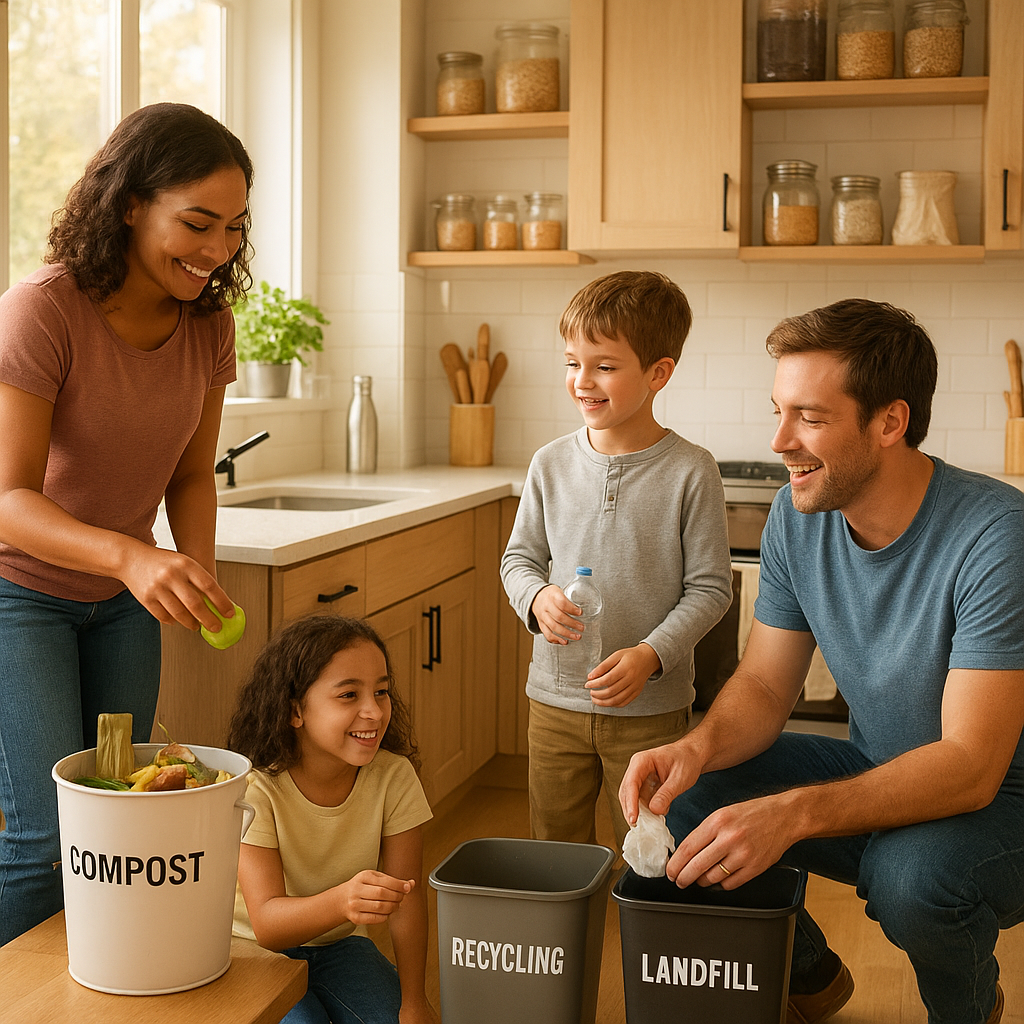
Composting — or “rotting” — is the final R, and it’s one that families with any outdoor space can embrace relatively easily. Food scraps, coffee grounds, and yard waste that might otherwise end up in a landfill can be transformed into nutrient-rich compost for gardens. Studies suggest that composting at home can divert as much as 30% of household waste from the trash.
Everyday Sustainable Habits That Actually Stick
The gap between knowing what to do and actually doing it consistently is where most eco-goals fall apart. Here’s what sustainable families actually do differently in their daily routines — not in theory, but in practice.
Rethinking the Weekly Grocery Run
Food choices are one of the biggest levers families have when it comes to environmental impact. Animal agriculture is responsible for an estimated 14.5% of global greenhouse gas emissions, according to the Food and Agriculture Organization of the United Nations. That doesn’t mean every family needs to go vegan overnight, but small shifts matter: incorporating more plant-based meals, buying seasonal produce, and reducing food waste by planning meals more carefully can add up significantly over time.
Many families find that meal planning — even loosely — cuts down on both waste and grocery spending. A rough weekly menu means fewer forgotten vegetables rotting in the crisper drawer and fewer last-minute takeout orders.
Rethinking Energy Use at Home
Heating and cooling account for nearly half of a typical home’s energy use. Simple adjustments — setting the thermostat a few degrees lower in winter, air-drying laundry when possible, using LED bulbs throughout the house, and unplugging devices that aren’t in use — can create a surprisingly noticeable dent in monthly utility bills.
Families who’ve invested in smart home technology often report that programmable thermostats alone can reduce heating and cooling costs by 10–15% annually. It’s one of those rare intersections where sustainability and financial savings genuinely overlap.
Rethinking How Kids Consume
Children are naturally prone to wanting the newest toy, the trendiest backpack, or whatever their friends have. Sustainable-minded families find ways to work with this tendency rather than against it — hosting toy swaps with neighbors, exploring thrift stores as an adventure rather than a compromise, or encouraging kids to save up for one quality item rather than accumulating many cheap ones.
These conversations, started early, tend to shape how children think about ownership, value, and consumption well into adulthood.
The 7 Principles of Sustainability
Beyond the household level, sustainability is often discussed through a broader lens — particularly in environmental science and policy circles. The seven principles of sustainability offer a more expansive framework:
- Interdependence: Recognizing that humans, ecosystems, and economies are deeply connected.
- Ecological limits: Understanding that natural systems have finite capacities.
- Equity and justice: Ensuring that sustainable practices don’t come at the expense of vulnerable communities.
- Long-term thinking: Prioritizing the future over short-term gains.
- Biodiversity: Protecting the variety of life that keeps ecosystems resilient.
- Quality of life: Sustainability isn’t just environmental — it includes social and economic wellbeing.
- Participatory democracy: Involving communities in decisions that affect their environments.
For families, the most relevant of these is probably the principle of interdependence. Sustainable choices rarely exist in isolation — choosing to compost supports soil health, which supports local agriculture, which supports community food security. Pulling one thread often affects the whole fabric.

Which Countries Lead the Way in Green Living?
It’s worth looking beyond the household to understand which nations have made sustainability a cultural and governmental priority. Consistently, Nordic countries top global sustainability rankings. Denmark, Finland, Sweden, and Norway regularly appear in the upper tier of the Environmental Performance Index (EPI), which evaluates countries on metrics including air quality, water sanitation, biodiversity, and climate policy.
Denmark, in particular, is frequently cited as a leader — with ambitious targets to become carbon neutral, a robust cycling infrastructure, and a national culture that genuinely values environmental stewardship. But it’s not just about wealth or policy. Cultural attitudes toward consumption, community, and long-term thinking play an enormous role in how green a country’s citizens actually live day to day.
The lesson for families isn’t that you need to move to Scandinavia — it’s that systemic support and cultural norms make individual sustainable choices significantly easier to maintain.
Practical Ways to Start (or Go Deeper)
Whether a family is just beginning their sustainability journey or looking to deepen an existing practice, there are always accessible next steps. A few worth considering:
- Audit your trash: Spend a week paying attention to what you’re actually throwing away. Patterns emerge quickly, and they point directly to where changes will have the most impact.
- Start a small container garden: Even a few herbs on a windowsill or a single tomato plant on a patio connects kids and adults alike to where food comes from.
- Switch to a green energy provider: In many states, households can choose electricity plans that source from renewable energy at little or no extra cost.
- Buy nothing groups and local swap communities: These neighborhood-based sharing networks reduce consumption while building community — a genuine two-for-one.
- Choose experiences over things: Research consistently shows that experiences contribute more to long-term wellbeing than material purchases — and they tend to have a lower environmental footprint too.
Sustainability as a Family Value, Not Just a Checklist
Perhaps the most significant shift that sustainable families describe isn’t any single habit — it’s a change in how they think about their relationship with the world around them. When sustainability becomes a shared family value rather than a set of rules to follow, it tends to self-propagate. Kids start pointing out unnecessary packaging. Partners start talking about purchases differently. Conversations that once seemed abstract — about climate, resource scarcity, environmental justice — start feeling personal and actionable.
That internal shift is where lasting change actually lives. No app, no checklist, and no perfectly curated zero-waste kitchen can replicate it. For families also looking to reduce their environmental impact on the road, small changes to everyday driving habits can complement the sustainable choices already being made at home.
Bringing It All Together
Sustainable living, at its best, is a practice — something that evolves over time, looks different for every family, and doesn’t demand perfection. The key principles center on reducing consumption, minimizing waste, and thinking beyond immediate convenience. The 5 R’s provide a practical everyday structure. And the 7 broader principles of sustainability remind us that what happens inside the home is always connected to larger systems.
Modern families who are doing this well aren’t necessarily those with the most resources or the most radical lifestyles. They’re the ones who’ve decided to pay attention — to their habits, their purchases, their waste, and their values — and who keep showing up for those choices even when it’s inconvenient. That’s what sustainable living actually looks like, and it’s more achievable than most people assume.